
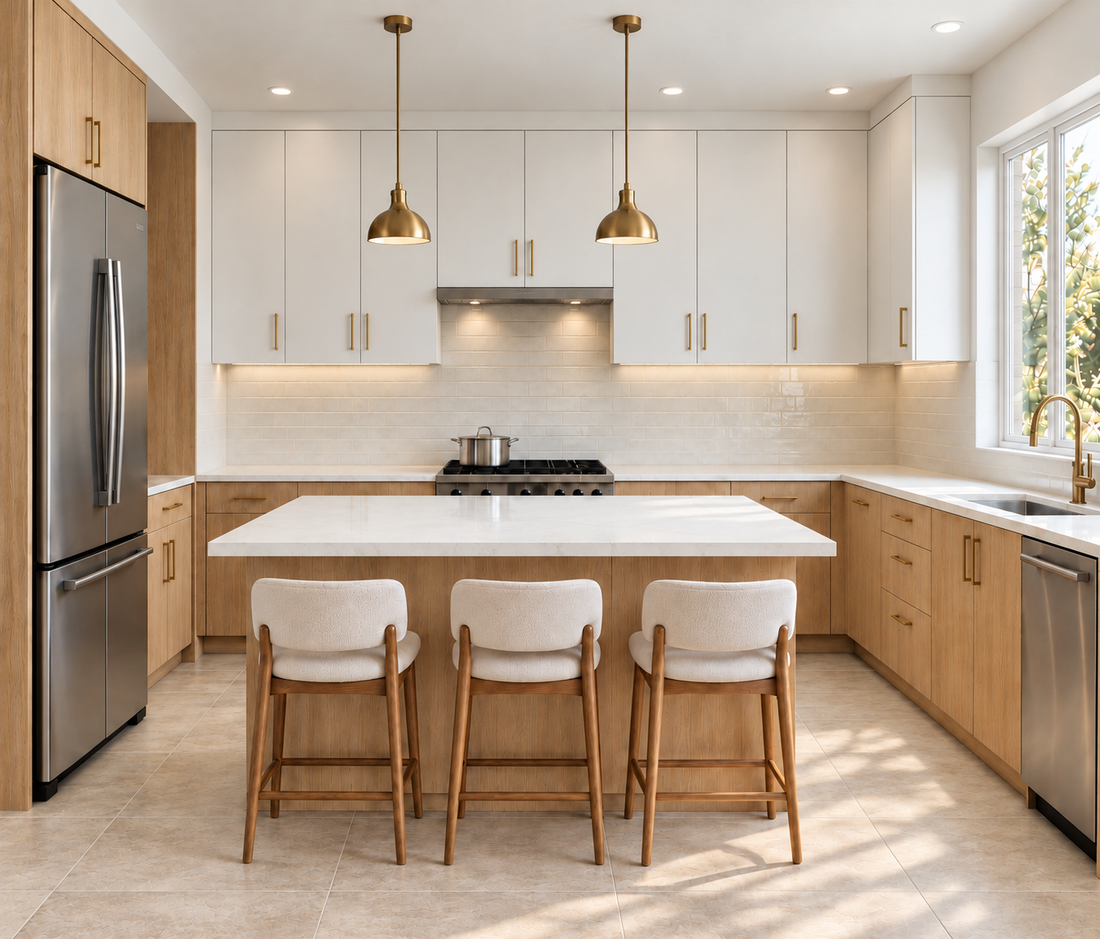
Why Kitchen Cabinet Quotes Vary: What Homeowners Should Compare
A kitchen cabinet quote can vary significantly from one project to another, even when two kitchens appear similar in size. Cabinet pricing is not based only on linear footage or room size. Cabinet construction, door material and finish, drawers, storage accessories, tall cabinets, finishing details, custom modifications, delivery and installation can all affect the final cost.
This is why comparing two quotations based only on the total price can be misleading. The more useful question is:
What is actually included in each quote?
At a Glance: What Affects Cabinet Pricing?
The main factors include:
- Cabinet type and construction
- Door material, profile and finish
- Number and type of drawers
- Tall cabinets and appliance cabinetry
- Storage accessories
- Panels, fillers, mouldings and trim
- Custom sizes or modifications
- Hardware specifications
- Delivery, assembly and installation
- Whether countertops or other work are included
Understanding these details makes it easier to compare quotations fairly and decide which features matter most for your kitchen.
Cabinet Type and Production Method
Cabinet systems based on established sizes, door styles and finishes can often be produced more efficiently. Fully custom cabinetry provides greater flexibility in dimensions, finishes and construction details, but may require more project-specific design and manufacturing.
The important question is not simply whether the cabinetry is prefabricated, fully custom or combines standard-sized cabinetry with selected custom components. It is how much customization the design requires and what specifications are included.
Standard-sized cabinetry may work well in many areas, while selected custom components can be used where the room, appliances or design details require them.
You can compare our cabinetry and door style options or read more about whether prefabricated cabinets are lower quality.
Door Style, Material and Finish
The cabinet doors and finish can have a noticeable effect on price.
A simple slab door generally requires a different manufacturing process than a Shaker, raised-panel or more decorative door. The door material should also be confirmed. Common examples include:
- Painted MDF
- Stained wood
- Wood veneer
- Laminate
- Textured decorative panels
- Other specialty materials
A painted MDF door, stained wood door and laminate slab door can create very different appearances and involve different manufacturing and finishing processes.
Colour may also affect pricing. A standard finish offered within a cabinet collection may be priced differently from a custom colour that requires separate colour matching, preparation and finishing.
When comparing quotations, confirm the door profile, material and finish rather than relying only on a colour name or sample image.
 Design concept showing how door colour, hardware and stone selection can change the overall appearance and scope of a kitchen.
Cabinet Box Construction
Cabinet boxes may be constructed from plywood, particleboard with finished or melamine interior surfaces, or a combination of materials, depending on the cabinet line and application. MDF is also commonly used for painted doors, panels and decorative components.
The material name does not tell the entire story. Other relevant details include material thickness, interior finish, shelf construction, back panels, reinforcement and how the cabinet is assembled.
A quotation using one box specification should not automatically be compared as though it is identical to a quotation using another.
Drawers and Storage Accessories
Drawer cabinets generally cost more than comparably sized door cabinets because they require drawer boxes, slides and additional hardware.
For example, a 30-inch cabinet with two doors is usually simpler than a 30-inch cabinet containing three drawers. Both occupy approximately the same amount of space, but the internal components are different.
The cost difference becomes more noticeable when a kitchen includes:
- Deep pot-and-pan drawers
- Internal drawers
- Roll-out trays
- Pull-out waste systems
- Pantry pull-outs
- Spice pull-outs
- Lazy Susan or blind-corner systems
- Specialized drawer inserts
These features can improve accessibility and organization, but they should solve a genuine storage need. Adding every available accessory can increase the cost without necessarily making the kitchen more useful.

Before selecting an accessory, consider what will be stored there, how often it will be used and whether a simpler cabinet arrangement could provide the same function.
Tall Cabinets and Appliance Cabinetry
Tall cabinets use more material and may require additional doors, shelves, panels and hardware.
Examples include pantry cabinets, oven cabinets, refrigerator surrounds, utility cabinets and floor-to-ceiling storage.
Appliance cabinetry can also require finished side panels, fillers and upper cabinets. Built-in ovens, microwaves and other appliances may need cabinets manufactured or modified around their specifications.
These details can make the kitchen look more complete, but they also add material, planning and installation time.

Panels, Fillers and Custom Details
Some of the most important parts of a kitchen are also the easiest to overlook when comparing quotations.
These components may include:
- Finished end and refrigerator panels
- Island panels
- Fillers beside walls and appliances
- Crown moulding
- Light valance
- Toe kicks
- Open shelving
- Glass-door cabinets
- Decorative trim
Fillers provide necessary clearance where doors and drawers open beside walls or appliances. Finished panels cover exposed cabinet sides, while mouldings help the cabinetry meet ceilings and surrounding surfaces more cleanly.
Custom details may also include non-standard cabinet widths or depths, cabinetry around windows or sloped ceilings, custom hoods, wine storage and appliance garages.
A quote that includes these components may appear higher than one that includes only the main cabinet boxes. The difference may be the completeness of the scope rather than the cost of the cabinets alone.
See examples of completed kitchen and cabinetry projects, or read about what a custom-designed kitchen really means.
 Design concept showing raised-panel doors, glass cabinetry, a custom-style hood, decorative island panels and detailed mouldings.
Hardware Specifications
Hardware specifications vary between cabinet collections.
Soft-close hinges and drawer slides may be standard in one collection but optional in another. Load capacity, extension, adjustability and the mechanisms used for pull-outs or specialty cabinets can also affect pricing.
A kitchen with many drawers, pull-outs and specialty cabinets naturally requires more hardware than a simpler layout. Confirm what hardware is included and whether it is appropriate for how the cabinet will be used.
Delivery, Assembly and Installation
Cabinet pricing and the total installed kitchen price are not always the same.
A quotation may include cabinet supply only, ready-to-assemble cabinetry, assembly, delivery, installation or a combination of these services.
Installation costs can vary based on the number of cabinets, layout complexity, tall units, large panels, mouldings, uneven walls or floors, property access and the amount of on-site fitting required.
A straight run of cabinets is generally easier to install than a kitchen with several corners, tall units, decorative panels and detailed trim.
Before comparing totals, confirm which services are included and which still need to be arranged.
Countertops and Other Project Costs
A cabinet quotation may not include every part of the kitchen project.
Countertops, backsplash, demolition, plumbing, electrical work, flooring, drywall repairs and painting may be included or quoted separately.
At Made to Measure Kitchen & Bath, cabinetry and countertops can both be included in the project quotation when requested. Learn more about our quartz and granite countertop process.
One quotation may cover cabinetry only, while another includes countertops, delivery and installation. The totals cannot be compared fairly until the scope is understood.
How to Compare Kitchen Cabinet Quotes
When comparing quotations, ask whether each includes the same:
- Cabinet box construction
- Door material, profile and finish
- Drawer construction and hardware
- Number of drawer and tall cabinets
- Panels, fillers, mouldings and trim
- Storage accessories
- Custom modifications
- Assembly and delivery
- Installation
- Countertops and other project work
- Applicable taxes
If one quotation is significantly lower, ask what is different. A lower price does not necessarily indicate better value, just as a higher total does not automatically indicate better cabinetry.
The objective is to understand what is being supplied and whether it meets the needs of the project.
Spend the Budget Where It Matters
A well-planned kitchen does not need every available cabinet specification or accessory.
For one household, additional drawers may make the biggest difference. For another, the priority may be pantry storage, cabinetry around an unusual wall, a custom hood or a better appliance arrangement.
It may also be possible to combine standard-sized cabinetry with selected custom components, depending on the layout and required finishes.
Two kitchens can have similar dimensions while containing very different amounts of cabinetry, hardware and finishing work. A clear quotation should show where the budget is going and help identify which features are most useful for your kitchen.
If you are planning a kitchen in Barrie or the surrounding area, contact Made to Measure Kitchen & Bath to discuss your space, priorities and budget or arrange a showroom visit.