
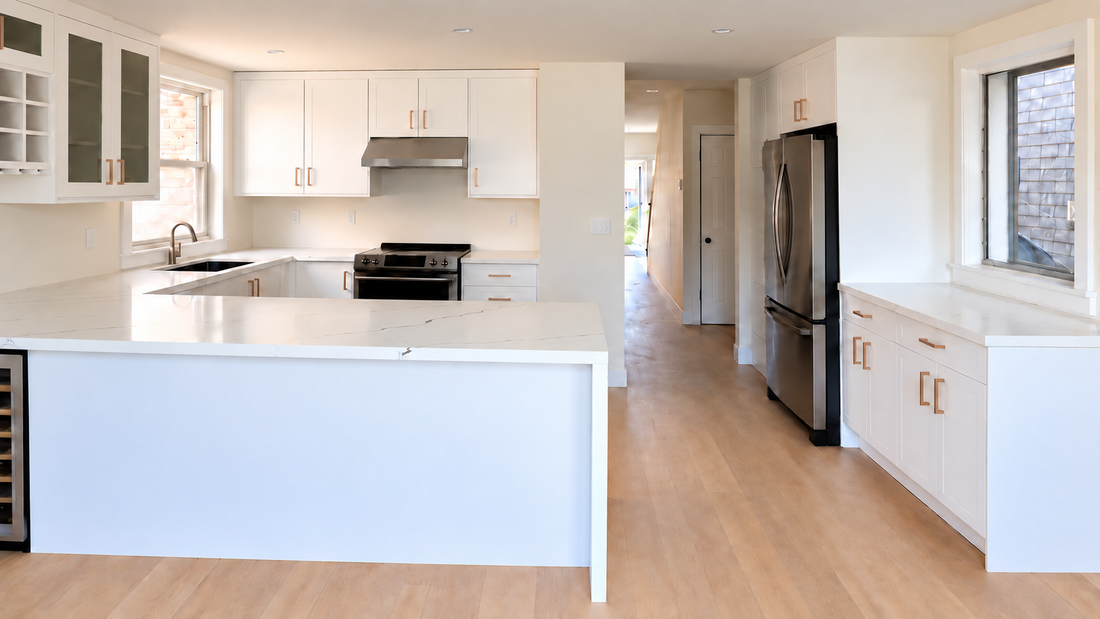
What Does a Custom-Designed Kitchen Really Mean?
When people talk about wanting a custom kitchen, they do not always mean the same thing.
For one homeowner, “custom” might mean a particular cabinet colour or door style. For someone else, it might mean improving an awkward layout, adding a decorative hood or creating storage for small appliances. Another homeowner may want every cabinet manufactured specifically for the room.
All of these can be valid reasons for wanting a custom kitchen. The first step is understanding the result you are looking for.
A custom-designed kitchen and fully custom cabinetry are related, but they are not the same thing.
Custom design starts with the room
A custom-designed kitchen begins with how you want the room to look and function.
The design should consider the size and shape of the room, appliance locations, storage needs and how the kitchen will be used. It should also reflect your preferred style rather than forcing you into a layout that does not suit your home.
For example, you may want more drawers instead of door cabinets, a place to keep small appliances off the main countertop or an island that provides both preparation space and seating. You may have a window, doorway or bulkhead that affects the cabinet layout.
These are design decisions. They need to be addressed before deciding how the cabinetry will be manufactured.
Two kitchens can use cabinets from the same collection and still produce very different results. The layout, proportions, finishes, countertop, hardware and special features all influence how the finished room feels.
Custom design is not the same as fully custom cabinetry
Fully custom cabinetry means the cabinets are manufactured for a specific project. Cabinet dimensions, door styles, materials and finishes can generally be selected with fewer restrictions than they can with an established cabinet collection.
This can be useful when you want a particular door profile or colour, need unusual cabinet dimensions or have a feature that cannot be created with available products.
Custom design describes something different. It means the overall kitchen is planned for you and your room.
A custom-designed kitchen may use fully custom cabinetry, but it does not have to. It may also use cabinets from an established collection or a combination of available and made-to-fit components.
The cabinetry is one part of the design. It is not the design by itself.
There is more than one way to build a custom-designed kitchen
Once the layout and design direction are understood, the next step is deciding how to carry them out.
Some projects work well with an established cabinet collection. These collections, sometimes described as prefabricated cabinetry, offer specific cabinet sizes, door styles and finishes.
Other projects are better suited to fully custom cabinetry because the intended appearance or dimensions cannot be achieved through an existing collection.
A third approach is to combine the two. The main kitchen may use available cabinetry while selected features are made or modified for the project.
For example, a kitchen might include:
- A countertop cabinet for small appliances
- A wine or beverage area
- Open shelving in a matching finish
- A decorative hood designed to suit the rest of the kitchen
These features can give the kitchen a more individual appearance without determining how every other cabinet must be manufactured.
In another project, the homeowner’s preferred door style, finish or proportions may make fully custom cabinetry the better choice from the beginning.
Neither approach is automatically right for every kitchen.


Cabinet labels do not tell the whole story
Terms such as prefabricated, RTA, semi-custom and custom are used frequently, but they do not always provide enough information on their own.
RTA means “ready to assemble.” It describes how the cabinet is supplied, not the complete material or quality specification.
“Semi-custom” can also mean different things between manufacturers. Some use it to describe a cabinet collection with selected modification options. Others use the term more generally.
Instead of relying only on the label, ask what is actually included:
- What cabinet and door styles are available?
- Which parts of the design will be made specifically for the project?
- What materials and hardware are included?
- Which features can be created in a matching finish?
- What will the finished installation include?
The answers will tell you more than the category name.
The conversation should begin with what you want
When you meet with a kitchen company, you should be able to explain what matters to you before being directed toward a particular product.
You may already know that you want fully custom cabinetry. If so, the designer should understand what you want to achieve with it.
You may know the appearance you want but not which type of cabinetry is needed. In that case, the designer should explain the available ways to create it.
Sometimes there is only one practical approach. In other cases, more than one cabinetry option may be able to produce a similar design. You should be shown the differences clearly so you can make an informed decision.
The purpose of the consultation is not to talk you into or out of custom cabinetry. It is to understand what you want and determine how it can be done properly.
Good design can be seen in the details
A kitchen can have attractive cabinets and still feel incomplete if the surrounding details are not properly planned.
The design should consider how the cabinets meet the walls and ceiling, how doors and drawers open, how the appliances fit and how the countertop relates to the cabinetry.
It should also consider the room as a whole. The island, perimeter cabinets, hood, open shelving and other features should look like they belong together.
These details may not be the first things you notice in a finished kitchen, but they often determine whether the result feels balanced and complete.
Which approach is right for your kitchen?
There is no single answer that applies to every homeowner.
An established cabinet collection may already offer the style and components needed for your design. Fully custom cabinetry may be the right choice when you want more control over the dimensions, materials or appearance. A combination may work well when most of the kitchen can use available cabinetry but a few features need to be made differently.
The decision should come after your needs and design preferences are understood.
Before moving forward, make sure you know:
- What type of cabinetry is being proposed
- Which features are standard and which are project-specific
- What materials and finishes are included
- What the company will provide as part of the project
- What still needs to be confirmed before ordering
A clear proposal should make these points easy to understand.
Begin with the design you want
The phrase “custom kitchen” does not have to describe only one type of cabinet.
It can describe a kitchen planned around your room, your preferred style and the way you want to use the space.
The cabinetry may come from an established collection, be fully custom-made or use a combination of both. What matters is that the design comes first and that you understand how the proposed cabinetry will be used to create it.
If you are planning a kitchen in Barrie, Simcoe County or the surrounding area, a few current photos, rough measurements and examples of styles you like are usually enough to begin the conversation.
You can view our cabinetry and door collections, see examples of completed projects, or contact us to discuss your kitchen.